
Introduction
You spent forty hours perfecting your resume.
You tailored every bullet point.
You triple-checked for typos.
You hit “Apply” on 200 job postings across LinkedIn, Indeed, and Glassdoor.
And then — nothing. Silence.
The digital void swallowed your application whole.
Here is the brutal, uncomfortable truth that no career counselor in South Asia, the Middle East, or Africa is telling you: your resume was dead on arrival.
Not because you lack talent.
Not because you lack experience.
But because you committed cardinal sins that instantly flag your application for the trash bin — both by human recruiters and by the Applicant Tracking Systems (ATS) that screen resumes before any human being ever touches them.
In 2026, the global job market has become a ruthlessly optimized machine.
Over 75% of resumes are rejected by ATS software before reaching a recruiter’s desk (Jobscan, 2025).
Of the remaining 25% that survive the algorithm, recruiters spend an average of 6 to 7.4 seconds scanning each one (Ladders Inc. Eye-Tracking Study).
That is not a window — that is a slit.
And if your resume contains the red flags we are about to expose, that slit slams shut.
This article introduces the Augmentron Resume Standard — a modern, ATS-optimized, globally competitive framework for building a resume that does not just survive the gauntlet, but dominates it.
The Silent Killer: Why Your Resume Gets Trashed in 6 Seconds

The modern hiring pipeline is not what most job seekers imagine.
There is no thoughtful hiring manager sitting in a leather chair, carefully reading your two-page life story over a cup of coffee.
The reality is industrial-scale screening.
A single job posting on LinkedIn receives an average of 250 applications (Glassdoor, 2024).
For competitive roles at companies like Google, Amazon, or McKinsey, that number can spike to 1,000+ applicants.
No human team can read 1,000 resumes thoughtfully.
So they don’t. Instead, the process looks like this:
- ATS Filtering (Stage 1): Software automatically parses, scores, and ranks every resume against the job description keywords. Between 60% and 75% of applications are eliminated here.
- Recruiter Scan (Stage 2): A human recruiter speed-reads the surviving resumes, spending 6–7 seconds each. Another 50%+ are eliminated.
- Hiring Manager Review (Stage 3): The final shortlist — typically 5–10 candidates — reaches the actual decision maker.
Your resume must survive a machine and then impress a human in six seconds.
Every element on that page either accelerates you forward or eliminates you.
There is no neutral ground.
Red Flag 1: The Photo Problem

In many countries — India, Pakistan, the UAE, Germany, Japan — attaching a photograph to your resume is standard practice.
In some cases, it is expected.
In the United States, the United Kingdom, Canada, and Australia, it is a disqualifying mistake.
Why?
Anti-discrimination law.
Title VII of the Civil Rights Act (US), the Equality Act 2010 (UK), and equivalent legislation across the Western world prohibit employers from making hiring decisions based on race, gender, age, ethnicity, or appearance.
When you attach a photo to your resume, you are handing the employer a potential discrimination lawsuit on a silver platter.
Here is what actually happens when a Western recruiter sees a photo on your CV:
- Large corporations have explicit policies to immediately reject photo-attached resumes to mitigate legal liability.
- Recruiters are trained to view photos as a sign that the candidate is unfamiliar with Western professional norms.
- ATS systems can be configured to flag or deprioritize resumes containing embedded images, as photos create parsing errors.
The Augmentron Standard is unambiguous: no photos, ever.
Your resume is a professional marketing document, not a dating profile.
Your face is irrelevant to your capacity to deliver results.
Red Flag 2: Marital Status, Age, Religion, and Nationality

This is perhaps the most culturally ingrained resume mistake that international job seekers make.
In South Asia and the Middle East, it is common — even expected — to include:
- Marital status
- Date of birth or age
- Father’s name
- Religion
- Nationality
- Number of dependents
- Passport number
In the West, every single one of these is a red flag.
These details are legally protected characteristics. Including them signals one of two things to a Western recruiter: either you are unaware of professional norms in the target market, or you are inadvertently asking the employer to discriminate. Neither interpretation helps you.
The Augmentron Standard mandates that your resume header contain exactly four elements:
- Full Name (first and last only — no “Mr./Mrs./Dr.” unless contextually critical)
- Professional Email (firstname.lastname@domain.com)
- Phone Number (with international dialing code)
- LinkedIn Profile URL (customized, not the default alphanumeric string)
That is it.
Nothing else.
No address.
No age.
No marital status.
No photograph.
The resume exists to demonstrate professional value — not to catalog your personal biography.
Red Flag 3: The Address Trap:

Including your full home address — “Flat 302, Sunshine Apartments, Andheri East, Mumbai, Maharashtra 400069” — on a resume applying for a remote role at a San Francisco startup is not just unnecessary.
It is actively harmful.
Three reasons your address hurts you:
1. Location Bias.
Research from the National Bureau of Economic Research (NBER) confirms that geographic bias is real. Applicants from certain zip codes, countries, or regions receive measurably fewer callbacks. If a recruiter sees an address 8,000 miles from the office, unconscious bias activates: “This person will need visa sponsorship,” “The time zone won’t work,” “Relocation is expensive.”
2. ATS Misclassification.
Many ATS platforms use location data to auto-filter candidates. If the job posting specifies “New York, NY” and your resume says “Mumbai, India,” the ATS may automatically eliminate you — even if the role is remote.
3. Privacy and Security.
In the era of data breaches and identity theft, broadcasting your physical address across hundreds of job applications is a security risk. Recruitment databases are frequently targeted by cybercriminals.
The Augmentron Standard:
Include city and country only if directly relevant (e.g., “Based in Toronto, ON — open to remote”). For remote applications, omit location entirely. Let your skills speak. Geography is not a qualification.
The ATS Black Hole: Why 75% of Resumes Never Reach Human Eyes

What Is an ATS?
An Applicant Tracking System (ATS) is enterprise software that automates the recruitment pipeline.
Think of it as the gatekeeper between your application and a human being.
The most widely used ATS platforms include Workday, Greenhouse, Lever, iCIMS, Taleo (Oracle), and SAP SuccessFactors.
Every Fortune 500 company uses an ATS. Over 99% of Fortune 500 companies and 75% of mid-size employers rely on ATS to manage hiring (Jobscan, 2025).
If you are applying to any established company, your resume is being algorithmically processed before it is ever seen by a person.
How ATS Parsing Works
When you upload or submit your resume, the ATS performs several operations:
1. Document Parsing.
The ATS extracts text from your file. It attempts to identify and categorize sections: contact information, work experience, education, skills. This is where formatting matters enormously. Tables, columns, headers/footers, text boxes, and graphics break ATS parsers. The system cannot read a beautifully designed Canva resume with infographic skills bars. It sees garbled text, misplaced data, or nothing at all.
2. Keyword Matching.
The ATS compares your resume text against the job description. It scores you based on the presence, frequency, and placement of relevant keywords. If the job description says “project management, stakeholder engagement, Agile methodology, Jira” and your resume contains none of these phrases, your match score will be critically low — regardless of whether you actually possess these skills.
3. Ranking and Filtering.
Based on the match score, the ATS ranks all applicants. Recruiters typically review only the top 10–20% of ranked resumes. If you scored in the bottom half, your application is functionally invisible.
4. Knockout Questions. Many ATS platforms include pre-screening questions: “Do you have a valid US work authorization?” “Do you have 5+ years of experience in X?” Incorrect answers result in instant elimination.
The Augmentron ATS-Optimization Process
The Augmentron Resume Optimization incorporates a rigorous ATS optimization protocol.
These are not suggestions — they are requirements for any resume that intends to compete in the modern job market:
File Format: Submit in .docx format unless the posting specifically requests PDF. While PDFs preserve formatting for humans, many older ATS platforms parse .docx more reliably. When PDF is required, ensure it is a text-based PDF, not a scanned image.
Layout Architecture: Use a single-column layout with clearly labeled section headers (Experience, Education, Skills, Certifications). No tables. No columns. No text boxes. No icons. No graphics. No headers or footers (ATS often cannot read content placed in Word headers/footers).
Keyword Engineering: For every application, extract the top 15–20 keywords and phrases from the job description. Integrate them naturally into your experience bullet points, skills section, and professional summary. Do not stuff keywords into white-text-on-white-background hidden sections — modern ATS platforms detect and penalize this tactic.
Section Headers: Use conventional, standard header names: “Professional Experience” (not “My Journey”), “Education” (not “Academic Adventures”), “Skills” (not “My Superpowers”). ATS parsers are trained on standard labels. Creative headers cause parsing failures.
Date Formatting: Use a consistent format: “Jan 2023 – Present” or “January 2023 – Present.” Avoid ambiguous formats like “2023-1” or “1/23.”
Quantified Achievements: Structure each bullet point using the CAR framework (Challenge → Action → Result): “Reduced customer onboarding time by 40% by redesigning the intake workflow using Salesforce automation, saving the team 200+ hours per quarter.” ATS and human recruiters both reward specificity and measurable impact.
The Augmentron Resume Modern Blueprint
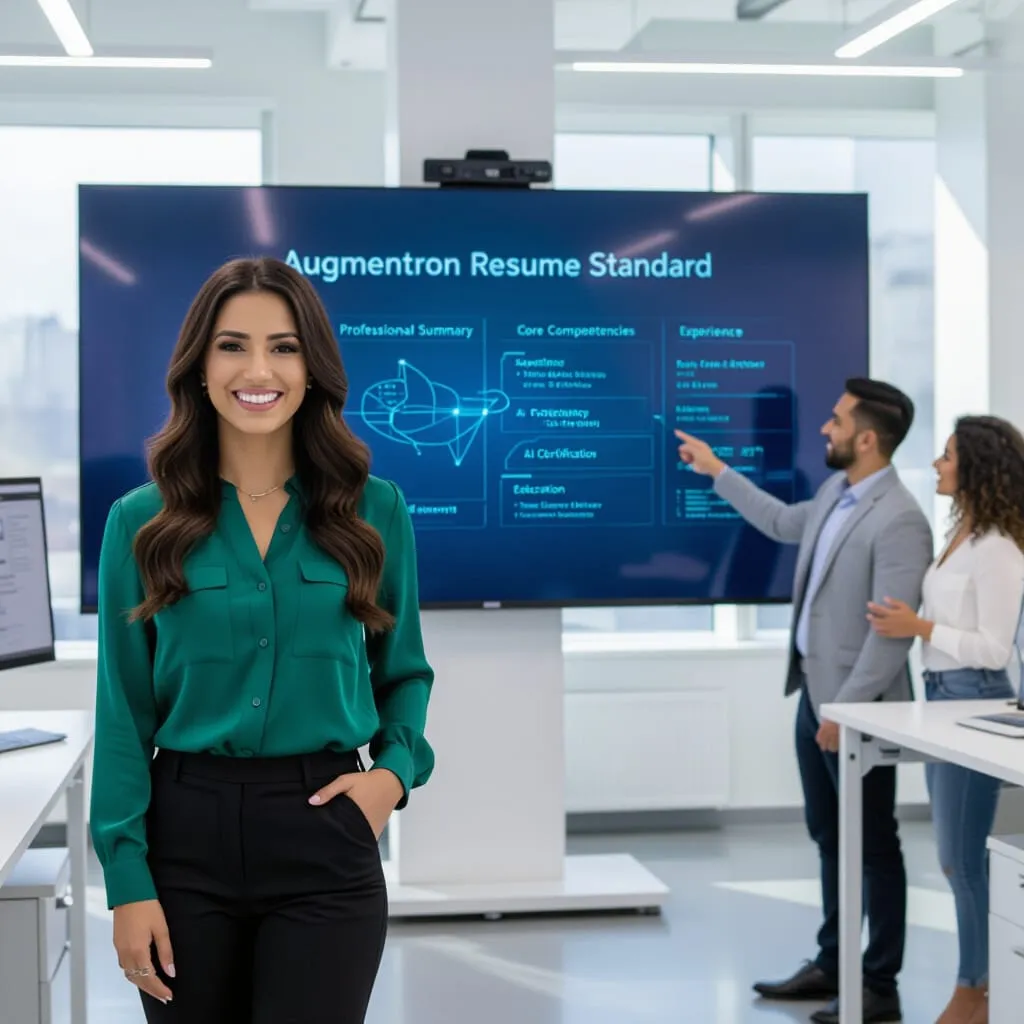
The Augmentron Resume Standard is a battle-tested framework designed for one purpose: maximum conversion rate from application to interview.
It is not a template — it is a methodology.
The Six Pillars:
Pillar 1: The Professional Summary (3–4 lines)
Not an objective statement.
Not a paragraph about your dreams.
A high-impact summary that immediately communicates: who you are professionally, your years of relevant experience, your top three domain competencies, and one quantified achievement.
Example: “Results-driven Product Manager with 8+ years of experience in B2B SaaS, specializing in AI-powered analytics platforms. Led cross-functional teams of 15+ to deliver a $4.2M ARR product line, achieving 97% on-time release rate across 12 product launches.”
Pillar 2: Core Competencies Grid
A 3×4 or 4×4 grid of keyword-rich skills, directly mirroring the language of target job descriptions.
This grid serves a dual purpose: it feeds the ATS keyword matcher and gives human recruiters an instant skills snapshot.
Pillar 3: Professional Experience (CAR Format)
Each role lists company, title, dates, and 4–6 bullet points using Challenge → Action → Result structure. Every bullet contains at least one metric. Roles older than 10–15 years should be condensed or removed.
Pillar 4: AI Proficiency (New: Critical for 2026)
A dedicated section showcasing AI tools mastery, prompt engineering capability, and AI-augmented workflow experience. This is no longer optional. It is a requirement.
Pillar 5: Education
Degree, institution, year. No GPA unless you graduated within the last 2 years and it exceeds 3.5/4.0. No high school. No coursework lists.
Pillar 6: Certifications and Continuous Learning
Industry-recognized certifications only: AWS, PMP, Google Analytics, HubSpot, Coursera specializations from top universities. No Udemy certificates of completion for a 2-hour course.
AI Is No Longer Optional: The Non-Negotiable Skill of 2026

Here is the single most important career insight of this decade: AI proficiency is no longer a bonus — it is a baseline expectation.
According to LinkedIn’s 2025 Global Talent Trends Report, job postings mentioning AI skills have increased by 21x since 2023.
A 2025 McKinsey survey found that 72% of companies have adopted AI in at least one business function, up from 50% in 2023.
Microsoft’s 2025 Work Trend Index reports that 75% of knowledge workers now use generative AI at work.
If your resume does not demonstrate AI competency, you are signaling to employers that you are a legacy candidate in a market that has moved on.
What AI Proficiency Looks Like on a Resume
The Augmentron Standard recommends a dedicated “AI & Emerging Technology” section that demonstrates:
Tool Literacy: Specific platforms you have used productively — ChatGPT, Claude, Gemini, Midjourney, DALL-E, GitHub Copilot, Cursor, LM Studio, Stable Diffusion, Runway ML, Notion AI, Jasper.
Workflow Integration: How you have embedded AI into your actual job. Examples:
- “Automated weekly competitive intelligence reports using GPT-4=5 and custom API pipelines, reducing analyst workload by 60%”
- “Deployed AI-assisted code review using GitHub Copilot, improving development velocity by 35%”
- “Created AI-generated marketing content pipeline using Claude and Midjourney, producing 40+ assets per month at 70% lower cost”
Prompt Engineering:
The ability to craft effective prompts is now a recognized professional skill. If you can demonstrate structured prompt engineering — chain-of-thought, few-shot learning, system prompting — you are immediately differentiated from 90% of candidates.
AI Ethics and Governance Awareness: For senior roles, demonstrating familiarity with AI governance frameworks (EU AI Act, NIST AI RMF, responsible AI principles) signals strategic maturity.
The Augmentron Standard positions AI proficiency not as a skills appendix but as a core narrative thread woven through your entire resume — from your professional summary to your experience bullet points.
The Formatting Discipline: What Augmentron Consultancy Enforces

Formatting is not decoration.
Formatting is function.
A resume is a data transmission document — its job is to transmit your professional value with zero friction to both machines and humans.
The Augmentron Formatting Rules:
- Font: 10–12pt professional sans-serif (Calibri, Arial, Helvetica, or Garamond). Never Comic Sans. Never decorative fonts. Never below 10pt.
- Margins: 0.5 to 1 inch on all sides. Tight enough to maximize content, wide enough for readability.
- Length: 1 page for early career (0–7 years). 2 pages maximum for experienced professionals. Never 3 pages. Executives with 20+ years may extend to 2.5 pages in specific contexts.
- Color: Black text on white background. One accent color maximum (navy blue or dark grey) for section headers only. No rainbow resumes.
- File Naming: FirstName_LastName_Resume.docx — not resume_final_v3_UPDATED(2).docx.
The Global Competitive Landscape: Why This Matters Now

The competition for knowledge-worker roles is no longer local — it is planetary.
A software engineer in Bangalore competes with peers in Berlin, Buenos Aires, and Baltimore.
A marketing manager in Lahore is stacked against applicants from Lagos, London, and Los Angeles.
In this hypercompetitive, globally flattened landscape, your resume is your product packaging.
And most candidates are shipping their product in a damaged box.
Consider the numbers:
- 65% of recruiters have rejected candidates specifically due to resume formatting issues (TopResume, 2024).
- 83% of hiring managers say that a resume that is not tailored to the specific role is an immediate turn-off (CareerBuilder Survey, 2024).
- Candidates who optimize for ATS receive 50% more interview invitations compared to those who do not (Jobscan, 2025).
The Augmentron Resume Optimization Process exists because the gap between “qualified candidate” and “hired candidate” is not talent — it is presentation.
The best-qualified person in the applicant pool often loses to the best-presented person.
This is not fair.
But it is real.
Conclusion: Your Resume Is Your Product - Engineer It Like One

Your resume is not a document.
It is an engineered product designed to accomplish a single objective: convert an application into an interview.
Every element must justify its existence.
Every word must earn its space.
Every formatting choice must serve the dual audience of machines and humans.
The Augmentron Resume Optimization Process distills this into actionable discipline:
✅ No photos. Your face is not a qualification.
✅ No personal data. Your marital status is not a skill.
✅ No full address. Your zip code is not a credential.
✅ ATS-first formatting. If the machine cannot read it, the human never will.
✅ Keyword-engineered content. Mirror the language of every job description. ✅ AI proficiency, demonstrated. If you are not leveraging AI in your work, you are already behind.
✅ Quantified achievements. Numbers are the universal language of professional credibility.
✅ Relentless tailoring. One generic resume for 200 applications is 200 wasted applications.
The job market of 2026 does not reward effort.
It rewards optimization.
The candidates who understand that their resume must survive an algorithm before it can impress a human — and who engineer their applications accordingly — are the candidates who get hired.
Stop hoping your resume is good enough.
Engineer it so that it cannot be ignored.
Visit and book an appointment with us to optimize your resume today!
Standard fees apply - you get what you pay for!

© 2026 Augmentron Consultancy. All rights reserved.
Augmentron Consultancy resume red flags ATS optimization applicant tracking system resume mistakes resume photo policy ATS-friendly resume resume formatting tips job search 2026 keyword-optimized resume Western resume standards resume personal information AI skills resume Augmentron Resume Standard career strategy recruiter resume screening resume address removal professional resume format resume engineering AI proficiency hiring
Comments