The Indian Student's Ultimate Guide to Opening an International Bank Account
Introduction (Conquering Huge Additional Fees)
Embarking on your study abroad journey is a symphony of excitement and ambition.
Yet, beneath the surface lies a complex challenge: navigating the financial landscape of a new country.
The questions can feel relentless.
How do you pay your tuition from India?
Should you open a bank account before you leave or after you land?
What is a GIC, a BRP, or an I-20, and why do they matter so much to a banker?
This definitive guide is your financial compass, designed to demystify the process, eliminate the anxiety, and empower you to manage your money with confidence from the moment you step off the plane.
Financial preparedness is not just about having enough funds; it's about having access to them efficiently and affordably.
Many students arrive armed with wads of cash or forex cards with punishing fees, only to face a frustrating weeks-long wait to open a local bank account.
This guide will help you sidestep those pitfalls, transforming a source of stress into a cornerstone of your new independent life.
The First Big Decision: Banking Before Departure vs. After Arrival

Opening an Account from India (The "Peace of Mind" Route)
Several global banks like HSBC and Citibank, and even some national banks in your destination country, offer programs to begin the account opening process while you are still in India.
- The Advantage: The primary benefit is security and compliance. You can transfer your tuition and a significant portion of your living expenses (GIC for Canada, for example) into a secure account before you travel. This satisfies visa requirements and means you don't carry large, risky amounts of cash. Upon landing, your funds are already in the country, waiting for you.
- The Reality: These are often "limited" or "non-resident" accounts initially. You will get an account number for transfers, but you won't receive a debit card or full account access until you visit a local branch with your passport, visa, and definitive proof of local address. The documentation required from India can be more intensive, and the process can take several weeks, so start early.
Opening an Account After Arrival (The "Maximum Choice" Route)
This is the most common path, offering a wider selection of banks and student-specific accounts with better perks.
- The Advantage: You can walk into multiple banks, compare their student packages in person, and choose the one with the best features, such as no monthly fees, a convenient branch location, or a sign-up bonus. The process is usually quick—often under an hour—once you have all your documents.
- The Pitfall: The "Bridging Period." For the first one to two weeks, you'll be in financial limbo. Relying on your Indian debit/credit card will incur foreign transaction fees (typically 2.5% + GST) and a currency conversion markup on every single purchase. A ₹1000 dinner could actually cost you closer to ₹1040. Over two weeks, these fees add up significantly. To mitigate this, a multi-currency prepaid forex card (from HDFC, Thomas Cook, etc.) is a crucial bridging tool.
Your Non-Negotiable Document Arsenal

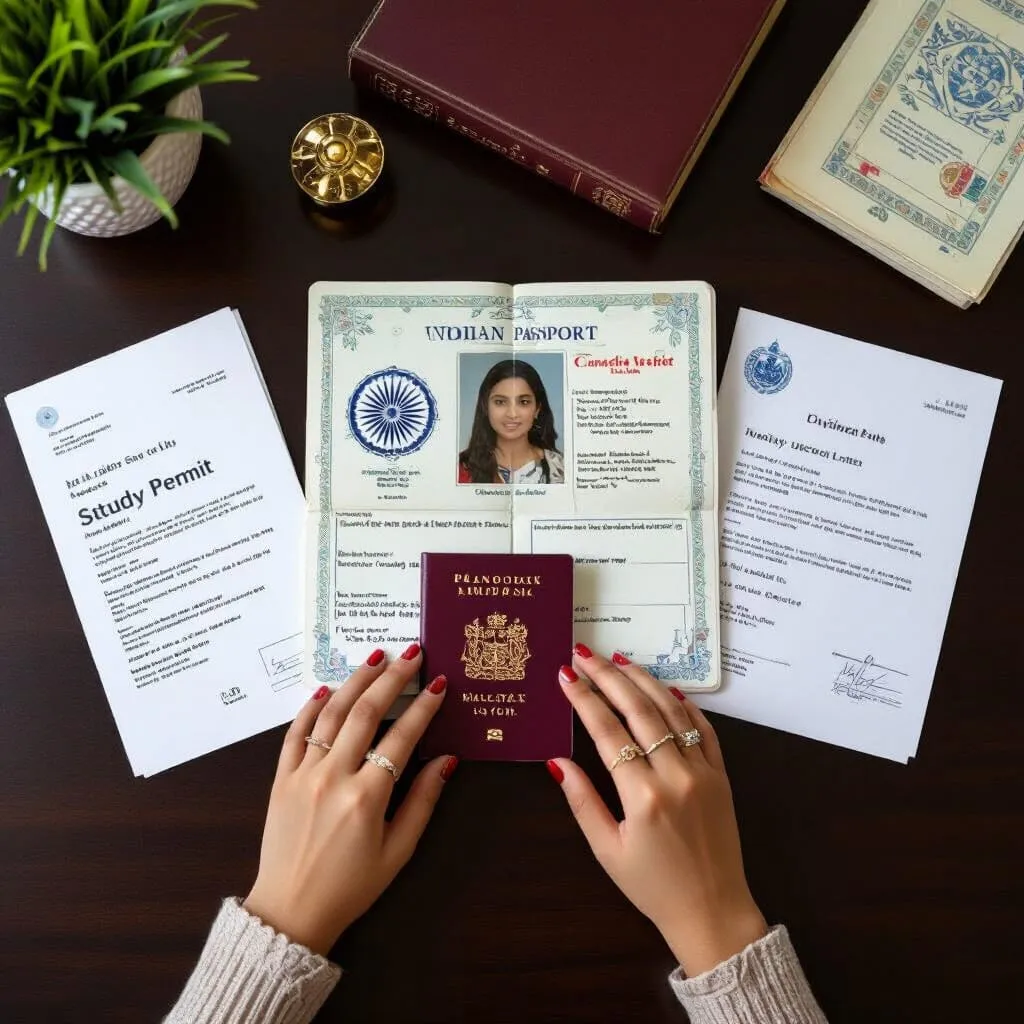
Gathering these documents is not a suggestion; it is a requirement. A missing document is the number one reason for delays.
- Primary Identification: Your passport is your identity. Ensure it’s valid for at least six months beyond your course duration. Pro-Tip: Make multiple photocopies and have a high-quality digital scan saved on your cloud drive (Google Drive, Dropbox) and emailed to yourself.
- Immigration & Academic Proof: This proves your legal right to be in the country and your status as a student.
- Canada: Study Permit (the document you receive at the port of entry).
- USA: F-1 Visa in your passport and your I-20 form.
- UK: Student Visa vignette in your passport and your Biometric Residence Permit (BRP), which you collect after arrival.
- Australia: Your Subclass 500 visa grant notice.
- Also Required: Your unconditional letter of acceptance from your university.
- Proof of Local Address: This is the most common hurdle for new students.
- What Works: A formal tenancy/lease agreement, a letter from your university's housing office confirming your dorm room, or a recent utility bill (which you won't have initially).
- What Often Fails: Hotel/Airbnb receipts, letters from friends, or temporary accommodation bookings are generally not accepted.
- The Solution: Most universities understand this. Their international student services can often provide an official "proof of enrollment" letter that includes your registered local address, which most banks will accept in your first few weeks.
Deep Dive: Popular Banks by Country
Canada: The GIC-Driven System

Canada's process is uniquely structured around the Guaranteed Investment Certificate (GIC), a C$20,635 (as of Jan 1, 2024) investment that proves you can support yourself. It makes your banking choice start even before you apply for your visa. Your banking culture revolves heavily around Interac e-Transfer, a seamless way to send money to anyone with a Canadian bank account and email address.
- CIBC (Canadian Imperial Bank of Commerce): A student favorite. The "Smart for Students" account has no monthly fees and their GIC program is seamless. Their mobile app's budgeting features are exceptional for students learning to manage finances.
- Scotiabank: A powerhouse due to its Student GIC Program and global footprint (Scotiabank is part of the Global ATM Alliance, offering fee-free withdrawals in many countries).
- RBC (Royal Bank of Canada): Canada's largest bank offers competitive student packages, often with sign-up perks like a free credit card or bonus reward points.
United States: A World of Choice

The US system is vast and competitive. You will open your account after arrival. You do not need a Social Security Number (SSN) to open a basic checking account, though you will if you get an on-campus job and for most credit cards. Banks will ask for your passport, F-1 visa, I-20, and proof of address.
- Chase Bank: Unbeatable physical presence. Their "College Checking" account is free for students for up to five years. Their nationwide ATM network means you're never far from your money.
- Bank of America: Another giant with a strong campus presence. Their "Advantage SafeBalance" account has student fee waivers and an excellent mobile app.
- Wells Fargo: Known for its widespread branches and student-friendly services, offering accounts designed for young adults starting their financial journey.
United Kingdom: Tradition and The BRP

UK banking is a mix of traditional high-street banks and modern digital challengers. Your single most important document after your passport is your Biometric Residence Permit (BRP). You collect this card after arrival, and you cannot open a full bank account without it and proof of address.
- HSBC/Barclays/Lloyds: These "high street" giants are reliable choices. Their student accounts waive fees and often come with valuable sign-up incentives, like a free multi-year 16-25 Railcard (saving 1/3 on all UK train travel).
- Monzo/Starling Bank: These are app-based "challenger banks." While they are incredibly user-friendly, opening an account as a brand-new arrival without any UK credit history can sometimes be more challenging than with a traditional bank. They are a fantastic secondary account option once you're settled.
Australia: The Big Four and the 100-Point Check

Australia allows you to start the application online from India, securing an account number to transfer funds. However, you must visit a branch in person after arrival to complete the "100-point check" for identity verification (your passport and visa will usually suffice) before the account is fully active.
- Commonwealth Bank (CommBank): Australia's largest bank, with the most extensive branch/ATM network and a mobile app that is consistently ranked as the best. Their "Student Everyday Account" has no monthly fees.
- ANZ/NAB/Westpac: The other members of the "Big Four" all offer very similar, competitive student accounts with fee waivers. Your choice may simply come down to which bank has a branch on or near your university campus.
The Modern Money Transfer Toolkit: Beyond Bank Wires

Sending money from India is governed by the RBI's Liberalised Remittance Scheme (LRS). How you send it can save you thousands of rupees.
Flywire: The Institutional Specialist
- What it is: A global payment platform that partners directly with thousands of universities. It is designed specifically for paying large sums like tuition and accommodation fees.
- How it Works: You select your university on Flywire's portal, it shows you the exact amount in INR (locking in the exchange rate), and provides you with multiple payment options (NEFT/RTGS, etc.). Flywire then ensures the university receives the exact amount they expect.
- Why use it: It's trusted by institutions, fully compliant with LRS, offers payment tracking, and eliminates the risk of "short payments" due to surprise intermediary bank fees. It's the gold standard for tuition.
Wise (formerly TransferWise): The Personal Funds Champion
- What it is: A service designed for sending personal funds abroad (e.g., your monthly living expenses).
- How it Works: Wise uses the real, mid-market exchange rate (the one you see on Google) and charges a small, transparent fee upfront. It avoids the high markups and hidden charges of traditional bank wires.
- Why use it: For sending money to your own international account from your parents' Indian account, it is almost always the cheapest and most transparent option. The savings on a C$1,000 transfer can be over ₹2,000 compared to a typical bank wire.
PayPal: The Convenience Trap
- What it is: A ubiquitous platform for small, quick payments.
- How it Works: Convenient for sending small amounts to friends.
- Why to AVOID for large transfers: PayPal's business model for international transfers relies on poor exchange rates. The rate they offer can be 3-5% worse than the mid-market rate. For a C$1,000 transfer, this hidden fee could cost you an extra ₹3,000-₹5,000. It's fine for paying for a pizza, but a terrible choice for living expenses or tuition.
Your Financial Journey Begins Now

Opening your first international bank account is more than a transaction; it's a declaration of your independence.
The process demands diligence, but the reward—financial security and freedom—is immeasurable.
By understanding the specific requirements of your destination, gathering your documents meticulously, choosing the right banking partner, and using modern tools to manage your money, you can conquer this crucial step with confidence.
Your education abroad is an investment in your future.
Making smart financial decisions from the very start ensures that your focus remains on your studies and experiences, not on battling bank fees or stressing about funds.
Frequently Asked Questions (FAQs) for Indian Students

Canada 🇨🇦
- Do I have to use the same bank for my GIC and my main student account?
- Yes, this is almost always the case. The GIC is a program offered by the bank that essentially "sponsors" your proof of funds. When you arrive, they activate the GIC and open your chequing account simultaneously, linking them so your monthly GIC payouts are deposited directly. It’s a package deal.
- How quickly can I build a credit history in Canada?
- You can start immediately. Apply for a student or secured credit card as soon as you open your bank account. By using it for small purchases (like groceries or coffee) and paying the balance in full every month, you can establish a positive payment history within 6-12 months. This is crucial for future phone plans, apartment rentals, or loans.
- What is an Interac e-Transfer, and why is it so important?
- It's the primary way Canadians transfer money to each other. Using just an email address or phone number, you can send money directly from your bank account to someone else's. It's used for everything from paying your portion of the rent to splitting a dinner bill. Most student bank accounts offer unlimited free e-Transfers.
- Can my parents in India transfer money directly to my Canadian account?
- Absolutely. They can use a service like Wise for the best exchange rates and lowest fees, or a traditional bank wire transfer. You will need to provide them with your Canadian bank's SWIFT code, your account number, and the transit number for your branch.
- My university is in a smaller town. Should I choose a big bank like RBC or a local credit union?
- For your first account as an international student, a major national bank (like RBC, CIBC, Scotiabank, TD) is highly recommended. Their processes for handling GICs and international student documentation are far more streamlined and established than smaller, local institutions.
United States 🇺🇸
- Do I really need a Social Security Number (SSN) to open a bank account?
- No. For a standard student checking and savings account, you do not need an SSN. You will need your passport, F-1 visa, I-20 form, and proof of address. You will, however, need an SSN if you get an on-campus job or want to apply for most standard (unsecured) credit cards.
- How do I choose between giant banks like Chase, Bank of America, or a university credit union?
- For convenience, a large national bank is often best due to their vast ATM and branch networks, especially if you plan to travel within the US. However, a university-affiliated credit union might offer slightly better interest rates and more personalized service. A good strategy is to start with a major bank and consider a credit union later.
- My university is in New York, but my friend's is in California. Will our banking experiences be the same?
- Largely, yes, if you both use a national bank. However, there are many strong regional banks in the US (like PNC in the East or U.S. Bank in the Midwest) that might offer competitive deals specific to that area. Banking regulations are federal, but product offerings can vary.
- What is the fastest way to get access to my funds after arriving?
- The quickest way is to carry some US dollars for your first 48-72 hours and use a prepaid forex card for other initial expenses. Visit your chosen bank branch within a day or two of arriving with all your documents. Your account is typically opened on the spot, and you can deposit cash immediately. Your debit card will arrive by mail within 7-10 business days.
- How important is building a "credit score" in the US?
- Extremely important. Your FICO credit score affects everything from your ability to rent an apartment without a large deposit, to getting a cell phone contract, to securing car insurance rates. Start building it immediately with a secured credit card from your bank.
United Kingdom 🇬🇧
- Can I open a bank account before I collect my Biometric Residence Permit (BRP)?
- It is very difficult. The BRP is the primary form of identification that banks use to verify your long-term right to reside in the UK. Schedule your bank appointment for a day after you have collected your BRP card.
- I don't have a utility bill for proof of address. What can I use?
- Banks understand this is a common issue for students. The best alternative is an official letter from your university. Go to your university's student services or registry office and request a "bank introduction letter" or a "proof of enrollment letter" which states your full name, date of birth, and your UK term-time address (even if it's a university dorm).
- What's the difference between a high-street bank (like Lloyds) and a digital-only bank (like Monzo)?
- High-street banks have physical branches, which can be comforting when setting up your first account. Digital banks are app-based, offering excellent user interfaces and budgeting tools. Many students start with a high-street bank for the initial setup and then open a Monzo or Starling account for daily spending due to their superior apps.
- Many banks offer freebies like a railcard or cash. Is it worth choosing a bank based on these?
- It can be! A 16-25 Railcard, for instance, saves you 1/3 on all train fares for up to three years, which can be worth hundreds of pounds if you plan to travel. As long as the account has no monthly fees and meets your basic needs, choosing one with a valuable sign-up perk is a smart move.
- Is my money safe in a UK bank?
- Yes. Deposits in any authorized UK bank are protected by the Financial Services Compensation Scheme (FSCS) up to a limit of £85,000 per person, per institution. This means your money is secure even if the bank were to fail.
Australia 🇦🇺
- What is the "100 Point Check" and how do I pass it as a student?
- It's Australia's system for identity verification. Different documents are worth different points. However, for international students, it's simple: your passport (70 points) and your student visa/university student card (40 points) will easily get you over the 100-point threshold.
- Can I open an account online from India and have a debit card waiting for me?
- You can start the process online and get an account number to transfer money into. However, you cannot get your debit card or full access to the funds until you visit a branch in person after you arrive and complete the 100 Point Check.
- I got a part-time job. My employer mentioned "superannuation." What is that?
- Superannuation (or "super") is Australia's mandatory retirement savings system. If you work, your employer must pay a percentage of your earnings into a super fund for you. You can typically access this money when you permanently leave Australia. You'll need to sign up for a super fund; your bank may offer one, or you can choose a separate one.
- Are the "Big Four" banks (CommBank, ANZ, NAB, Westpac) my only options?
- While they are the most popular and convenient choices for initial setup, there are other banks like ING, Macquarie, and various customer-owned banks that may offer better interest rates on savings. It’s wise to start with one of the Big Four for ease of setup and then explore other options for your savings once you are settled.
- How do I pay for things in Australia? Is cash common?
- Australia is a largely cashless society. The vast majority of transactions are done via "tap-and-go" with a debit/credit card or a phone (Apple Pay/Google Pay). While it's good to have a small amount of cash for emergencies, you will primarily rely on your card.
Your Journey to Financial Clarity Starts Here

Feeling overwhelmed by GICs, SWIFT codes, and foreign transaction fees?
You've just read the ultimate guide, but reading is one thing—executing it perfectly is another.
At Augmentron Consultancy, we transform financial complexity into complete peace of mind.
We are your dedicated partners, ensuring your transition to a new country is financially seamless and secure.
Our expert advisors specialize in:
Navigating the GIC process for Canada with trusted partner institutions.
Guiding you to the best student-friendly banks in the US, UK, and Australia.
Assisting with education loan applications and documentation.
Advising on the most cost-effective fund transfer methods to save you money.
Let us handle the intricate financial details so you can focus on what truly matters: your education and your future.
Don't start your adventure stressed about banking—start it with confidence.
Ready for a smooth financial take-off?
Visit us at www.augmentronconsultancy.com to schedule your personalized consultation with one of our expert advisors today.