Why Every Student Needs to Master AI Prompting (And How Our Online Course Will Help)

73% of students who don't understand AI-assisted learning will be at a significant disadvantage in 2026.
Not because AI is replacing human intelligence—but because students who know how to orchestrate AI are operating at 3x efficiency while you're still highlighting textbooks at 2 AM.
You're drowning in essays, research papers, and problem sets.
Meanwhile, your classmates breeze through the same workload.
The difference?
They've unlocked the ability to architect their workflow with AI as a strategic partner, not a cheating shortcut.
The fear is real—"If I use AI, am I even learning?"
But mastering AI prompting isn't about letting technology do your thinking.
It's about amplifying your capacity to think better, faster, and more clearly.
By the end of this guide, you'll understand how 12 focused days can transform you from an overwhelmed student into an AI-fluent academic leader who confidently tackles PhD-level challenges.
From Zero to AI Fluency: The 12-Day Transformation

This isn't a course with 12 lessons—it's 12 milestones building your competitive advantage.
Day 3: The Logic Breakthrough.
The exact moment when AI finally understands complex multi-step reasoning. Students call this their "holy shit!" moment.
Day 8: Your AI Team.
Orchestrate multiple AI agents working together—one researching, one outlining, one fact-checking.
Day 10-12: The Research Revolution.
NotebookLM mastery lets you synthesize 50+ academic sources in hours instead of weeks, with perfect citations automatically anchored.
Quick wins start immediately.
Day 1, you'll write prompts that actually work.
Day 4, you're solving calculus with step-by-step reasoning.
This works whether you're a high schooler struggling with essays or a PhD candidate preparing to defend.
90% of students report completing capstone projects 3x faster—not because AI does the work, but because they've mastered strategic workflow architecture.
What You'll Actually Learn (Not Generic AI Basics)

Pillar 1: Foundations (Days 1-3)
Master the actual mechanics of how AI understands instructions.
This isn't "be nice to ChatGPT"—it's understanding context windows, temperature settings, and multi-step reasoning chains.
You'll go from "write me an essay" to "analyze three peer-reviewed studies, identify conflicting conclusions, and synthesize a balanced perspective with citations.
Pillar 2: Advanced Techniques (Days 4-6)
Day 4 teaches chain-of-thought reasoning for complex logic.
Day 5 focuses on academic writing—literature reviews, research proposals, peer responses.
Day 6 is STEM mastery: differential equations, debugging code, analyzing datasets.
You'll go from struggling with 50-page papers to extracting key insights in 10 minutes.
Pillar 3: Automation & Teams (Days 7-8)
Learn workflow automation and multi-agent orchestration.
Imagine one agent conducting literature review while another maps theoretical frameworks while a third generates bibliography entries.
This is having a personal research team.
Pillar 4: Research Mastery (Days 9-12)
Day 9 addresses AI ethics—what's acceptable, what crosses the line.
Days 10-12 dive into NotebookLM: source anchoring (automatic citation), multi-modal synthesis (combining PDFs, articles, transcripts), and thesis defense prep.
PhD candidates achieve in weeks what typically takes months.
These techniques are based on proven research from OpenAI, Google, and Anthropic.
Real Student Success Stories

Sarah, Sophomore | Political Science
Before: 15+ hours weekly on research papers.
After: Same quality in 5 hours.
"I finally understand how to talk to AI like a research partner, not a robot. My professor even commented that my analysis has gotten sharper."
Marcus, Junior | Computer Science
Before: Generic portfolio, couldn't articulate value.
After: Optimized descriptions, landed fintech internship.
"The workflow automation module changed how I present my work. I got the offer two weeks after implementing these techniques."
Dr. Asha, PhD Candidate | Neuroscience
Before: Drowning in 200+ papers, imposter syndrome.
After: Thesis completed four months early.
"The NotebookLM module alone saved me 100+ hours. I found research gaps I'd completely missed in manual review."
James, High School Senior
Before: Essay anxiety, perfectionism.
After: Authentic essays, three reach school acceptances.
"The techniques helped me find my voice without sounding like a robot wrote it."
Why You Can't Just 'Figure Out AI' on Your Own

You could try learning this yourself.
YouTube has thousands of tips.
Reddit has threads.
But most students waste 30-40 hours trying random techniques.
You learn "basic prompts" but never discover PhD-level frameworks.
You pick up pieces without understanding how they work together.
You have no idea what to prioritize.
The hidden costs compound.
You miss advanced techniques (multi-agent orchestration, source anchoring, automation).
You build broken workflows.
You never develop strategic direction.
Structured learning: Every lesson builds intentionally.
You master proven techniques in 12 days instead of six months of scattered experimentation.
You join a community learning together.
Students who follow structured training master complex prompting 5x faster than DIY learners—and develop strategic frameworks that apply to every future challenge.
Who Should (and Shouldn't) Take This Course

Perfect for:
- High school seniors writing authentic college essays quickly
- Undergrads managing multiple courses wanting to reclaim 10+ hours weekly
- Master's students struggling with research synthesis
- PhD candidates defending world-class dissertations
Already know some AI?
You'll breeze through Days 1-3 but gain unprecedented techniques in Days 7-12 that even experienced users rarely discover.
Who shouldn't take this:
- Looking for shortcuts to avoid real work
- Comfortable with current pace
- Only learn through passive video watching
Required:
Practice with AI daily during the 12-day intensive.
90 minutes daily commitment for genuinely life-changing ROI.
The NotebookLM Breakthrough (Days 10-12)
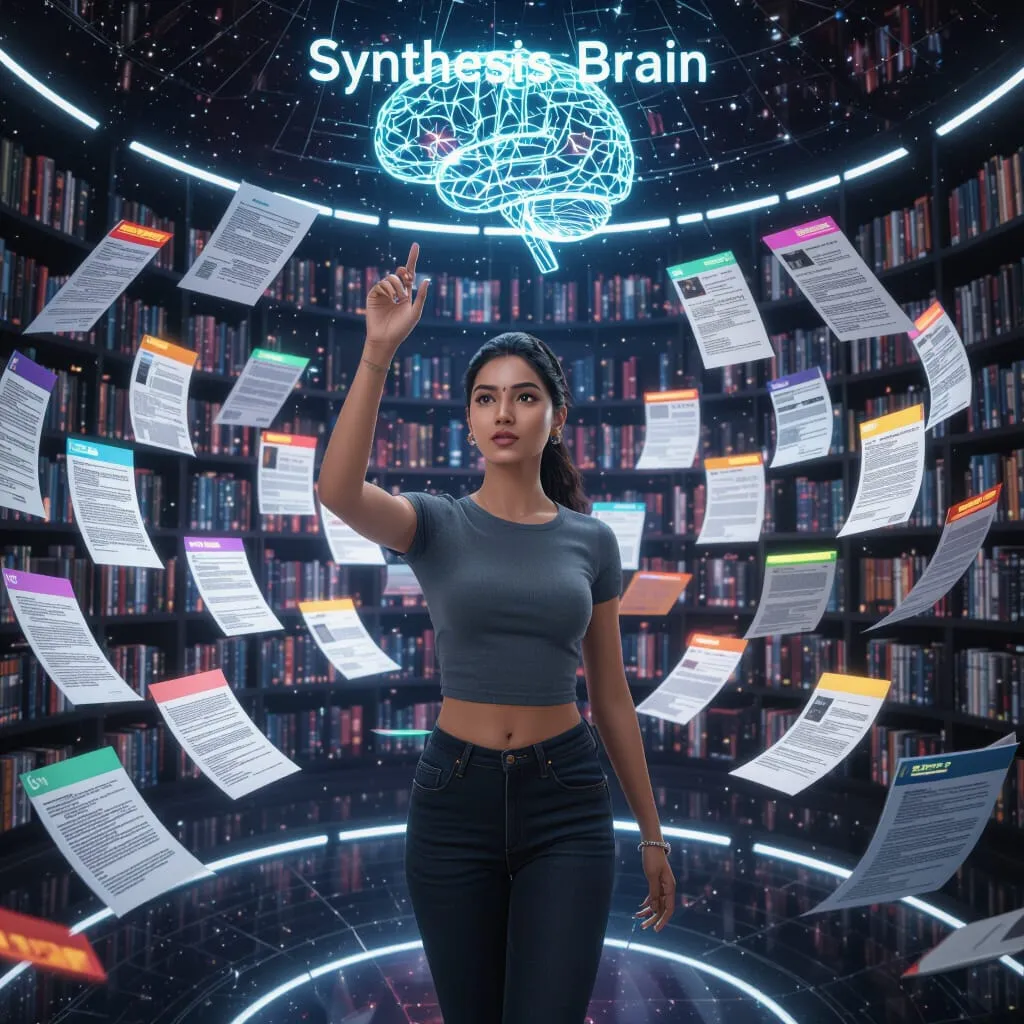
NotebookLM doesn't just summarize—it understands how multiple sources connect, conflict, and complement each other.
You can anchor citations to exact source locations. It creates study guides, audio overviews, and Q&A from YOUR sources.
The transformation:
Before: Literature reviews take 40-60 hours drowning in disconnected sources.
After: 30-50 sources synthesized in 6-8 hours with perfect citations and organized insights.
Use cases:
- Master's lit review: Analyze 100+ papers in depth
- PhD dissertation: Identify genuine research gaps
- Undergrad projects: Compare conflicting studies, find reconciliations
Days 10-12 secrets:
- Advanced source anchoring (automatic page citations)
- multi-modal research (combining PDFs, articles, transcripts)
- thesis defense prep (simulate peer reviewers).
PhD candidates report completing literature reviews 3-4x faster with 2x better clarity.
This is the secret weapon most students don't know exists.
Transform Without Sacrificing Authenticity

"Doesn't AI just do the work for you?"
No.
This teaches AI as a research partner, not a replacement.
Like using a calculator in calculus—the tool doesn't understand.
You do.
What happens:
- You: Ask right questions, evaluate sources, synthesize insights, make arguments
- AI: Organize information, check logic, suggest frameworks, save time on grunt work
- Together: Faster, clearer work that's more authentically yours
Academic integrity:
Day 9 explicitly teaches ethical boundaries.
Every example demonstrates transparent AI use satisfying academic standards.
Authenticity:
When you use AI strategically, you find your voice faster.
You're not spending 20 hours on busywork—you're spending time on genuine thinking.
Professors can tell.
Graduates sound more confident, not less.
Students who learn ethical AI use actually improve critical thinking—focusing on "why" and "so what" instead of busywork.
Ready to Become an AI-Fluent Academic Leader?

Twelve days from now, you'll be confident in AI collaboration, efficient in research, positioned for success in ways your peers haven't discovered.
This isn't buying a course.
This is investing in your competitive advantage for the next decade.
Students who master AI strategically—ethically, powerfully, authentically—stand out in every classroom, graduate program, and career opportunity.
You won't just pass classes—you'll lead them.
You won't just finish assignments—you'll innovate.
You won't just graduate—you'll graduate ready for what's next.
We built this because we believe in your potential—not just to survive academically, but to thrive.
Are you ready?